
Macro research · Japan / United States
Japan’s Rate Normalization
Repatriation, Carry Trades and Global Capital Flows
The central question
What happens to global capital flows when one of the world’s largest pools of savings no longer needs to leave home in search of yield?
01 / Context
A monetary regime in motion
For nearly three decades, Japan stood apart from most developed economies. By the 1980s, it had become the world’s second-largest economy; its GDP reached $5.54 trillion by 1995, reflecting momentum built during the bubble years. Persistent low inflation, weak wage growth and repeated episodes of deflation pushed the Bank of Japan (BoJ) toward increasingly unconventional monetary policies.
Interest rates remained close to zero, government bond yields were heavily compressed, and the yen became one of the cheapest major currencies to borrow. These conditions shaped the Japanese economy and global capital allocation, encouraging Japanese investors to seek yield abroad and making the yen a widely used funding currency.
Japan’s monetary regime is changing — a reminder of mujō, the Japanese idea that no state is permanent. On 18 September 2026, two days after the US Federal Reserve raised rates, the BoJ lifted its policy rate from 1.00% to 1.25%, its highest level in 31 years. The move extends a normalization cycle that began when the BoJ ended negative interest rates in 2024. Japanese government bond yields have also moved sharply higher.
02 / Market transmission
Repatriation and the carry trade
Capital repatriation
Higher domestic yields can make Japanese bonds more attractive relative to foreign bonds after currency hedging.
Yen carry trade
A changing US–Japan rate gap can alter the incentive to borrow in yen to fund higher-yielding assets abroad.
Higher Japanese rates can change where Japanese capital is allocated. For years, low domestic yields led banks, insurers and other institutions to look abroad for returns, particularly in US and European fixed income. As Japanese yields rise, that tradeoff becomes less obvious. For those investors, the relevant comparison is not simply between headline Treasury and Japanese government bond (JGB) yields: it is the return on foreign bonds after FX hedging costs versus the yield available at home.
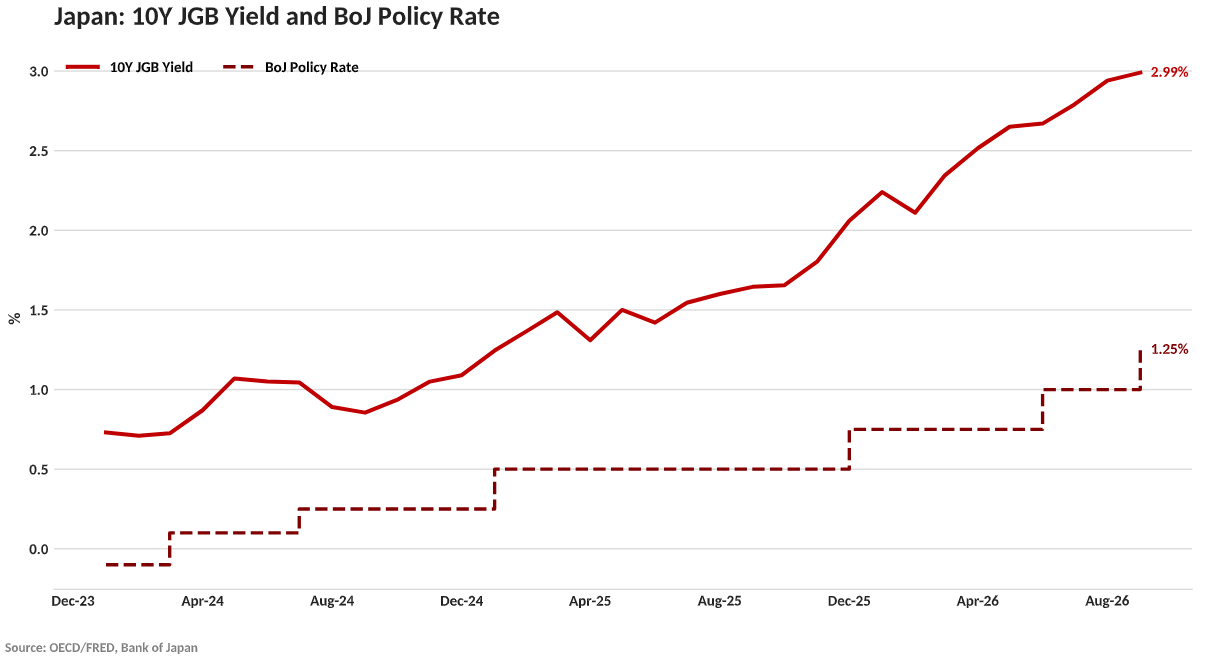
As JGB yields rise and currency hedging reduces the effective return on foreign bonds, domestic fixed income becomes relatively more attractive without the same FX exposure. This creates the possibility of domestic capital repatriation: Japanese investors may gradually reduce foreign holdings and reallocate some capital back to Japan.
The mechanism matters globally because Japan is one of the world’s largest pools of savings. At the end of 2025, Japanese investors held around ¥1,806 trillion in foreign assets, including roughly ¥769 trillion in portfolio investments. Significant repatriation could put pressure on foreign bond prices and lift yields, tightening financial conditions beyond Japan.
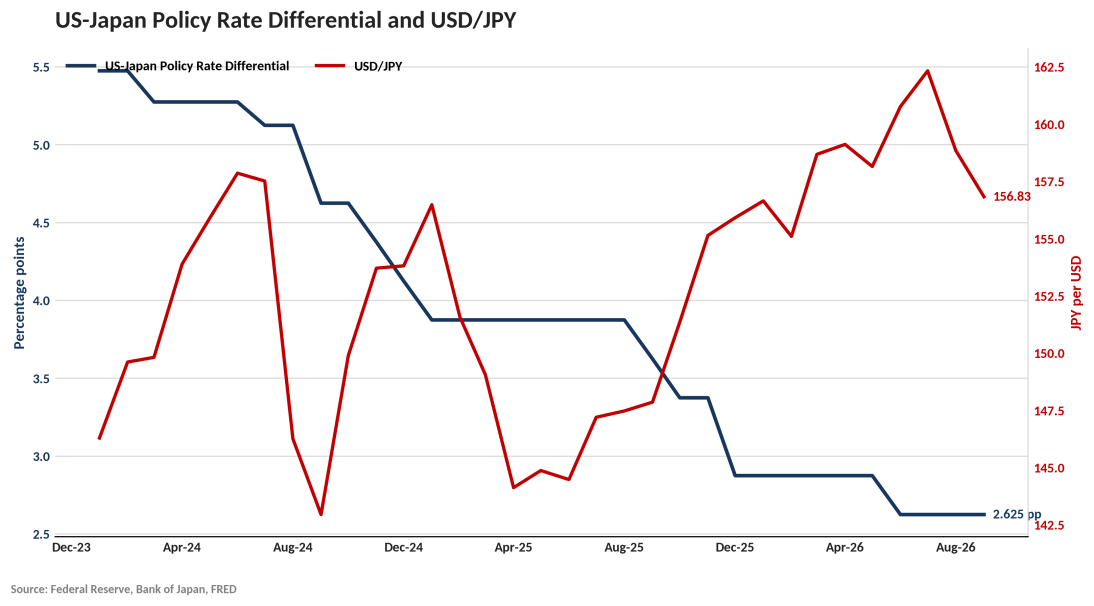
The second channel is the yen carry trade: investors borrow cheaply in yen and invest the proceeds in higher-yielding assets abroad. The latest Fed and BoJ decisions show why expectations matter more than the headline moves. Both central banks raised rates by 25 basis points, so the current US–Japan rate differential barely changed. The question is how that gap evolves next.
03 / Outlook
Why the carry trade may persist
My view is that the Fed still has room to remain restrictive. US headline inflation was 3.4% year on year in August 2026, above the Fed’s 2% objective, while Chair Kevin Warsh has signalled that the Fed is prepared to act if inflation persists.
The BoJ, by contrast, appears more cautious. Its latest 25 basis point hike passed by a 7–2 vote, with two board members favouring more patience. To me, this reinforces the idea that Japanese normalization is likely to remain gradual.
If this policy divergence persists, the US–Japan rate differential could remain wide enough to preserve the yen carry trade’s appeal. The real risk comes from a reversal in expectations: faster BoJ tightening or eventual Fed cuts would narrow the spread, encourage carry-trade unwinds and potentially strengthen the yen.
04 / Indicators
What to watch next
The next stage depends on how expectations for both central banks evolve. I am watching USD/JPY, the US–Japan rate differential, JGB yields and Japanese portfolio flows. A stronger yen alongside rising JGB yields could be an early signal that repatriation is gaining momentum. If US yields remain high and the BoJ normalizes only gradually, the carry trade could remain resilient.
The question ahead
At what point do Japanese yields become attractive enough to materially change global capital flows?
Sources & disclosures
Data and analysis are dated 19 September 2026. Sources cited in the original research include the Bank of Japan , US Federal Reserve , Japan’s Ministry of Finance , the US Bureau of Labor Statistics and Bloomberg. The charts are reproduced from my original PDF; the header image is an editorial illustration.
Disclosure. This note reflects my personal views as of its publication date and is provided for information and education only. It is not investment advice, a solicitation or a recommendation to buy or sell any security or financial instrument. Figures and market conditions may change; readers should check primary sources and make their own assessment before any investment decision. Opinions, scenarios and projections involve uncertainty.
Noé Saulet
All macro research